Tango Fast Track
How Learning Argentine Tango Works
A quick preview
This is a brief introduction to how learning Tango works, for beginners and curious aficionados who want to know how this journey may look and feel, and what they are getting into.
Here is the short version. Tango is now commonly taught through standardized curricula, which make learning the foundations faster and more reliable. Most teachers focus on giving you a working version of the dance. But keep in mind that this starting point is just a template, and it will look and feel quite different from what you see when an experienced dancer dances socially. Whether that gap matters to you depends on who you are and why you are here.
You will notice that many people are perfectly happy learning figures they can repeat and patterns they memorize by copying a teacher. There is nothing inferior about this approach. For a beginner, something easy to reproduce that approximates the real thing is good enough, and that's fair. It can even be exciting! Not everyone is passionate about Tango in the same way, or interested in its deep cultural tradition or in going beyond the steps. But there are always a few who feel its potential and the fire within it, and they want to go deeper, and quickly. They are ready to invest their time and emotional energy and go for more. It is like a mysterious calling. This piece I am sharing is for both kinds of students, and especially for the second.
How Tango learning became standardized
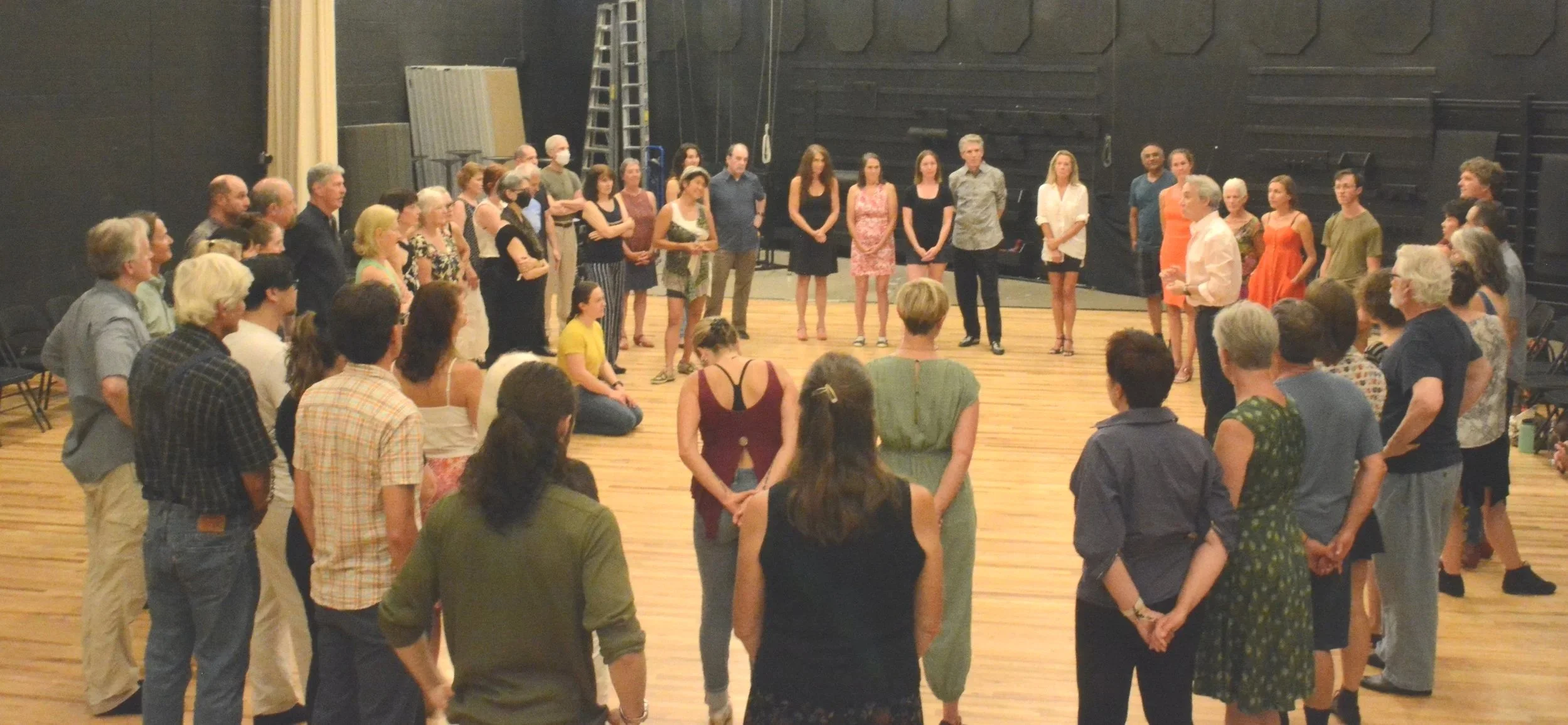
First, a very brief history lesson, in case you are not familiar. Argentine Tango had a golden era in Buenos Aires in the 1940s and almost disappeared after the mid-1950s. It made a comeback in popularity in the late '80s and early '90s. That return was catapulted through the stage. All of a sudden, the young dancers of that generation, who saw it come back and were interested in dancing and teaching it, began developing new methods to help people learn, faster and more reliably, a form, style, and culture that was almost extinct. I count myself as a member of that generation. Until then, the content had been passed on organically, mostly through verbal and community tradition.
Fast forward four decades and find yourself outside of Argentina. Tango teachers there often present learning built around a curriculum that a school or a collaborative of teachers has developed over the years, one that tries to capture the essential elements and pass them on reliably (Montreal is a good example). It is foundational content inspired by core principles and basic rules learned from Argentine teachers and their own experience. Some schools have a fairly fixed curriculum; others are more flexible. To make this concrete, some offer only a few levels (two or three), followed by theme-based classes where, after the basics, students are left to recombine and integrate the content. Others offer more levels (up to eight) to give students a stronger base in structures and techniques.
A curriculum covers the foundational pillars of learning a social dance:
Connection
Structure, known as figures or patterns
Technique
Some basics of musicality
Some basics of improvisation and navigation
The rest of the Tango learning journey is left to the student to discover, learn, and integrate, whether through private classes or through their own research: traveling, visiting other studios, or finding other ways to learn Tango. In my experience, the majority of students get lost after the foundational levels. They struggle to integrate and solidify their intermediate skills, and end up disoriented, collecting figures, decorations, and intricate choreography that they rarely enjoy. This scenario is what pushes most intermediate dancers to step away and quit Tango after a year or two.
Social dance versus choreography
Now, some perspective on the problem of learning traditional Tango. Argentine Tango is, in its origins and at its core, a community and social dance. This means that the casual aficionado will get the most value and the richest experience from its social form. A casual student can want to join the social floor and still be content with the basics learned in Tango school, using those first steps to enjoy social dancing.
But there is a deeper layer waiting. At the core of this dance's history, remember that people invented Tango spontaneously, and it was designed to transform them as people. Tango was the social fabric and the language of a society. It was not a spectacle but a tool of self-expression and personal craft. You may be more familiar with its performative form. Over the years it has also developed other variants, such as competition and performance. Sometimes these forms use the same principles as social Tango, and sometimes they don't.
What matters for the curious aficionado who wants to go deep is to tell the difference between learning choreography (memorizing patterns that always repeat the same way) and something very different: having a conversation, improvising, and expressing yourself more spontaneously.
Keep this distinction in mind as you read the next section, because a curriculum built on fixed patterns, however useful, sits closer to the choreography end of that spectrum than most students realize.
How a curriculum is built
The full Tango curriculum, in three paragraphs. Students usually receive a set of patterns built on a grid, made of different kinds of boxes.
The first is called the box step, or the cuadrado in Spanish.
The second is called the basic step. It is very similar to the cuadrado, but it has a cross before the end.
Within that grid, the curriculum integrates pivots, usually called ochos. There are front ochos and back ochos.
Once students have integrated the ochos, or have a fair understanding of them, they are introduced to a more intricate structural pattern: the turn, also called the molinete or medialuna. The ocho is a binary structure with two steps and two pivots, while the turn has three steps or elements. That makes it a little more complicated, but also more exciting, creative, and intricate to integrate.
The limits of grids and pivots
Here is where the rubber meets the road. The structure of grids and pivots is very good for building a solid, functional foundation in Tango, but it is not very useful for social Tango. How much that matters to you, or whether you even notice it, depends on the student.
For students who mostly want to get on the dance floor, this is not a problem. For students who are drawn to the social dance itself, it quickly becomes one. This is what we see: when dancers stick to the grid, many of them get bored because the material is simple and predictable. They check out. Leaders start repeating movements that lose their meaning and self-expression. Somehow these students forget about the things that brought them to Tango in the first place: the connection with their partner, the conversation, the relationship, self-expression, and musicality. This is where their suspicion becomes reality: what they learn in a school curriculum looks and feels very different from what they see when a master dancer dances socially.
To resolve this, students take a few different approaches. Some take more classes to learn more steps, but those soon become just as predictable, which usually buys them a year at most. Others take classes in what is called close embrace, since they see most people dancing close at social events. This gives them a preview of how the original patterns can adapt to a more realistic environment. Some teachers and schools approach it differently, building these concepts into the original structure and bending its shape a little, so that it becomes less rectangular, square, and repetitive, and more nuanced. Teaching more advanced forms of improvisation also helps.
My own approach is to use as many tools as possible and see which ones work best for each student's ambition and personality: figures, patterns, and techniques to build your vocabulary, while adding improvisation, musicality, and dance composition techniques to accelerate your learning.
Where students go from here
For those who want to go beyond the basics, there are two main directions:
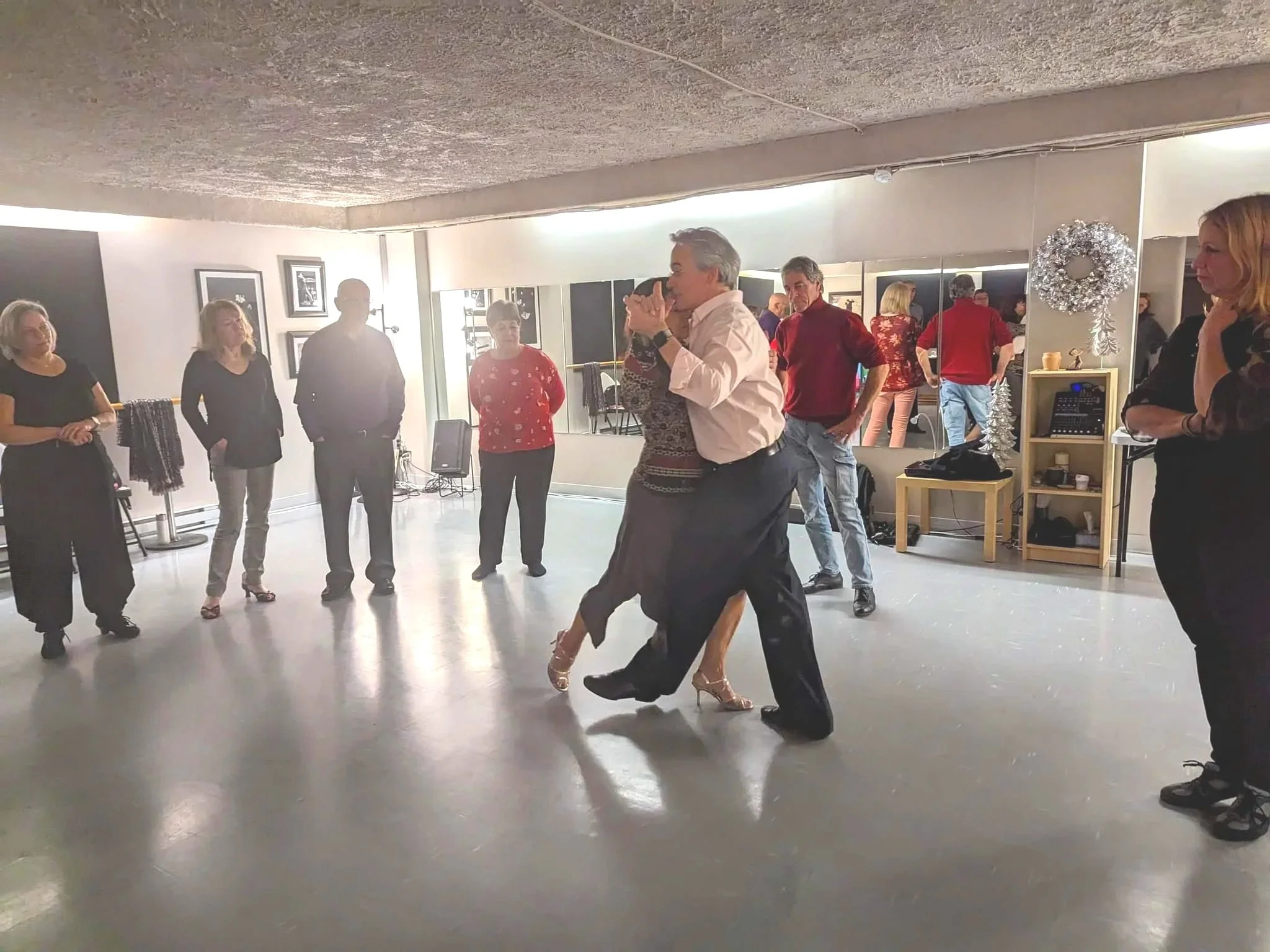
Some move into choreography and show dancing, when that is available in their town.
Others move into social dancing, because it is closer to what they have available or what interests them.
Traveling to Argentina is one powerful way to go deeper in either direction.
The rest of this piece is about the social path, since that is where I focus my teaching.
Going beyond the grid
In our work together, I show you the patterns so you are familiar with them, but I also want to get you beyond them as quickly as possible. That way you learn to improvise, develop stronger technique, and are pushed (in a friendly way) to communicate with a partner in a more nuanced and granular way.
The two principles below are the core of that approach.
Two essential principles
Always listen and relate to the music. If you don't, you never develop that foundational skill, and your movements become empty, with no relationship to any kind of dancing. This is often alienating, or frustrating for dancers who discover it years later in their learning process.
Onset and offset. If you set the patterns aside, there are only a few very simple things going on structurally in Tango:
You dance in front of your partner.
You dance beside your partner.
You travel or you turn.
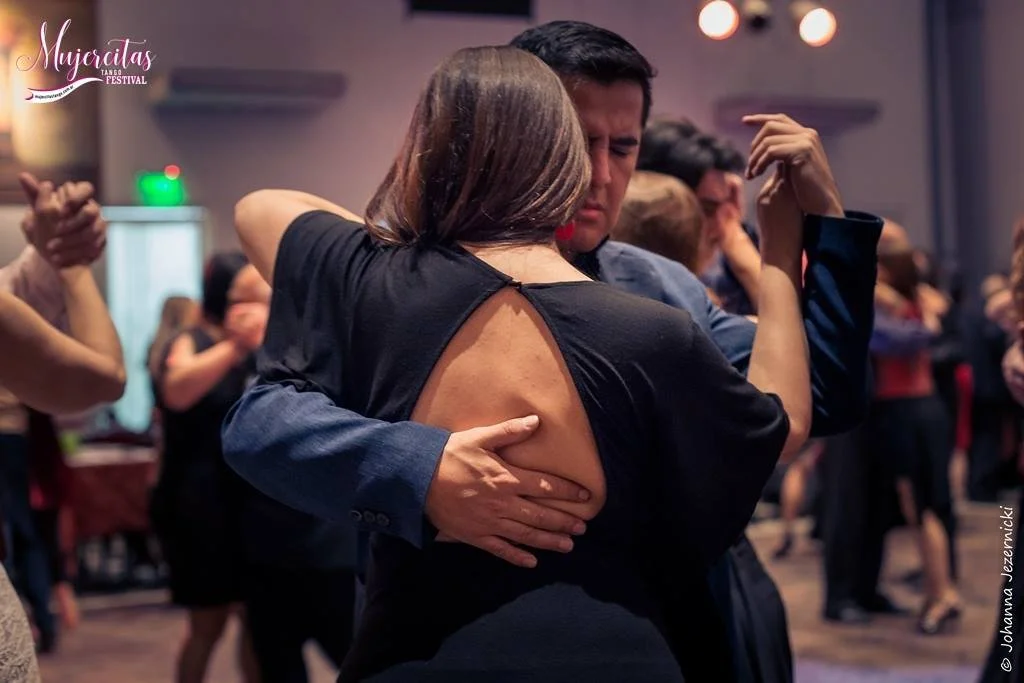
I call this onset and offset (facing partner versus standing beside your partner). It is very useful because it is a shortcut to how all the steps work, or may work. It is also a challenge, because you no longer have the side step at the beginning and end of the pattern to ground your memory and give you a break. You can still use the side step, but now you know its purpose: to give you a pause, or to let you dance beside your partner. When you dance beside your partner, we call it the cross-body position (torsion). Both dancers' bodies are beside each other, no longer facing each other. Here you can see the opportunity to lead a pivot and move into the ocho position.

How to accelerate your learning
Notice your social skills as soon as possible, and realize that they become the center of attention later in the learning process. At that stage, they translate into learning how to collaborate with your partners, getting the best dances, and learning how to study and grow your knowledge. All of this requires sophisticated social and collaboration skills. In the meantime, you keep working on technique, musicality, and everything else, but those recede into the background while social dynamics, relationship skills, charisma, and the ability to connect take center stage.
Once you leave the grid, the way you learn changes, so a few things matter more. To speed up your learning, focus on these:
Practice. If you don't practice, you don't advance. For every hour of instruction or private learning, put in at least one hour of practice, a 1:1 ratio. More is even better. When you practice, you become autonomous and in charge of your own learning process, which also accelerates it.
Relationship. Without a set of figures and techniques to copy, nobody is hiding behind the steps anymore. You are responsible for what you are doing. This means giving each other feedback on timing, variation, use of force, expressivity, and musicality. You are in charge, and you need to know how to ask for what you need at any given moment, while staying kind and patient with each other. When things don't work, simply make a list and bring it to your teacher at your next meeting.
Remember that social dancing is not practicing. Social dancing is the goal, and the place where you use what you have learned. It hones your social skills: reading the room, connecting with different partners, adapting in the moment. But it does not make you technically better or more sophisticated. That kind of progress comes from study, which happens separately, in practice sessions with your partner or in private lessons. Multiplying your hours in a social environment strengthens what you already do, but it doesn't refine your technique. What makes you better is the loop between instruction and practice.