Time for Practica
You've arrived at a resource born from over 35 years of dedicated practice and teaching. These articles form a pathway—one that has helped countless dancers transform their tango from something they repeat to something they embody.
A practice blueprint
When you approach your tango practice in an organized and systematic way, you are able to increase the benefits to your dancing over a shorter period of time. In this article, I will suggest a blueprint to help you get the most out of your practice time.
First, think about something specific you what to improve on. You need to be precise and choose something you have already learned. “I want to become the best dancer I can possibly be,” is a good thought for general inspiration, but it is not a good objective for practice. Whereas, “being able to take bigger steps after a 180-degree pivot,” is a precise objective that is focused enough for you to achieve.
Photo by Jay Mantri
Once you have found your specific objective, let’s make sure it is suitable for a practice session. To do this, test it and refine it using the framework below.
Context: Does my practice objective sit within a more general theme?
Feature: What component of this theme is my focus?
Success target: Does my objective have a component I can measure to determine if my practice has been effective?
You need an overarching context, a precise feature, and an achievable success target for your objective. This part of the blueprint will help clarify your understanding of the task and define the skill set you will need to work on. Let’s go through each point together using the practice objective from above: I want to be able to take bigger steps after a 180-degree pivot.
Context
A context can be a general subject heading that usually establishes the technical theme. Using my example objective, the context is pivoting. Remember that for this to be practice, your context comes from something that you have already received instruction on, something that you generally understand and can execute with basic proficiency. Do not choose something that is vague, or something that you want to learn but never took a class on. You will become frustrated and less likely to keep practicing.
FEATURE
A feature is a word or group of words that further defines your context, and renders your objective even more precise. It is a way to determine if your objective has sufficient parameters to help you focus your practice. For example, if our context is pivoting, the feature is pivoting at a 180-degree angle.
SUCCESS TARGET
The success target will tell you when you have achieved your practice objective. Continuing with my example, the success target would be: succeeding to take larger steps after a 180-degree pivot. You can even be more specific here and add to your objective “without losing balance,” or “four times in a row.”
This process of testing and refining your objective is extremely useful if you want a successful practice session. If your objective is too broad and its structure is not clear, it will take you too much time to get where you want to be. This is not how practice works at its best. You want to achieve your practice objective in the shortest possible period of time to keep the momentum you need to stay motivated and to continue practicing. The time commitment is the last important consideration in this practice blueprint.
TIME COMMITMENT
“Practice is a way to upgrade your movements.”
Let me give you a formula that many of my students find useful: one hour of practice for every one hour of learning you receive. It is a one to one ratio that is easy to remember and it will help you remain honest about how much you can learn and take home after class, and balancing this with an effective practice.
As you can see, practice is a way to step up your dance. If your objective is executing something you understand and consider relatively accessible to achieve, practice is a way to upgrade your movements. It can also help cement certain movements in your body knowledge through consistent repetition over a set period of time. This allows you to perform those movements on demand and without hesitation.
In my years of teaching, I have noticed that most students appreciate the nuance and see the power of practice. Some students may believe that because they intellectually understand the instructions they can execute the move. Other times, some believe that because they can execute the move a few times in class, they will be able to repeat it later. The truth is that, in the large majority of cases, both are not realistic. If you want to consistently perform what you have learned you need to put in the practice time.
In my following article I will write about some of the challenges that practicing has and how to overcome them. Also, how to come up with your own practice objectives.
The beauty of Argentine tango isn't found only in the dances or classes. It lives in the quiet and focused moments when you practice alone, when you refine your movement quality, when you discover new depths in each step. This is where real growth happens.
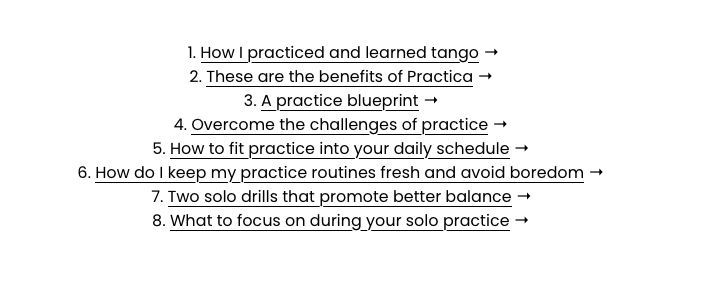
I've arranged these articles in a specific sequence, each building on the insights of the previous one. Start with the first and move through them in order—they'll take you from understanding why practice matters, to knowing exactly what and how to practice, to overcoming the inevitable challenges that arise.
Whether you're just beginning your tango journey or you've been dancing for years, dedicated practice will open doors you didn't know existed. These articles are your guide.
Let's begin.