Time for Practica
You've arrived at a resource born from over 35 years of dedicated practice and teaching. These articles form a pathway—one that has helped countless dancers transform their tango from something they repeat to something they embody.
What to focus on during your solo practice
Solo practice is the most valuable habit you can adopt when dancing tango. My tango teachers all told me countless stories about the discoveries they made during their solo practice sessions. They made sure I understood how valuable practicing on my own was. This is why I always recommend solo practice.
Photo by Paul Skorupskas
When practicing on your own, I suggest you focus on the five pillars of solo tango technique: stability, mobility, form, movement quality, and musicality. Make sure you understand what these five areas of tango technique are and how to work on them.
Balance the effort you dedicate to each of these five areas. For example: don't overwork your leg extensions (form) and forget your musicality (following the musical phrase.) Following a well-balanced practice is essential. Work on the five pillars equally. If you favor one area over another, sooner or later, it will catch up with you, and you will find it harder to tune your dancing. You end up training yourself to be unbalanced. For example: the more you only work your form, the harder you will find it to be musical with your movements. You will discover that your form forces you to follow specific musical patterns, impacting your dynamic range in your musicality.
“Solo practice is what makes students progress the fastest in their dancing.”
I recommend that you look at your solo practice as a project. Let me give you a model. There are five pillars of solo practice and five weekdays. Focus on one pillar a day. Your practice sessions can be as short as ten minutes a day.
Take a close look at each of the pillars and decide what aspect needs the most urgent attention. For example: if you are working on mobility, observe and study your own mobility and select which part of your body needs to be woken up. It might be your ankle joint or your shoulder blades. Write that down so you can remember it later.
Dedicate an entire session to one thing so you can see what you are doing well and what needs attention. You might realize that you need to take a class or ask your teacher for new ideas or directions that will help you work on what you are focusing on.
Solo practice can be less fun than practicing with someone else, but your efforts will be rewarded. I have seen it over and over—solo practice is what makes students progress the fastest in their dancing.
The beauty of Argentine tango isn't found only in the dances or classes. It lives in the quiet and focused moments when you practice alone, when you refine your movement quality, when you discover new depths in each step. This is where real growth happens.
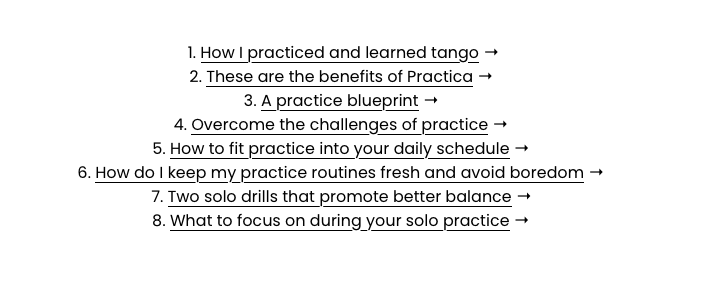
I've arranged these articles in a specific sequence, each building on the insights of the previous one. Start with the first and move through them in order—they'll take you from understanding why practice matters, to knowing exactly what and how to practice, to overcoming the inevitable challenges that arise.
Whether you're just beginning your tango journey or you've been dancing for years, dedicated practice will open doors you didn't know existed. These articles are your guide.
Let's begin.