Time for Practica
You've arrived at a resource born from over 35 years of dedicated practice and teaching. These articles form a pathway—one that has helped countless dancers transform their tango from something they repeat to something they embody.
How I practiced and learned tango
When I first set out to learn tango many years ago, I wanted to become very good and do so quickly. This was my plan: I would find a good teacher and practice as much as I could. In my mind, learning and practicing were not separate. Luckily, this was how tango was taught in Buenos Aires at the time, except for the quickly part.
Tomás & Silvana Grill, 1998
In Buenos Aires, tango was taught differently than it is today. Classes took place in the evenings and lasted longer. They included a lot of time for exploration and practice. There was less new content to capture, and more time to figure things out. Also, class and practice were intertwined, they were mixed together.
Today, these two aspects of learning are kept separate, and this affects how quickly and deeply people learn. Tango students are not exposed to the same model I encountered. Now, class and practice are set apart and each have their own time. During class, there is no time for practice; teachers speak more than they let students dance. You will not hear more than one song go by without a teacher intervention. Today, you can attend weekly classes, collect tons of information, and never practice. This is the current model for teaching tango.
This situation has generated the following scenario: most new and intermediate tango dancers do not practice—especially in smaller communities where opportunities to dance are scarce—and so they don’t improve fast enough. Faced with a daunting and steep learning curve, they are tempted to quit.
Did you know that at least three out of four new dancers give up in the first year of tango? This is not surprising—who wants to invest so much in an activity that cannot be mastered in a reasonable time frame?
“Practice closes the gap between the rookie and the expert dancer. It is what creates, feeds, and grows a healthy tango community.”
But if practice is what makes the crucial difference and new dancers want to learn, why is it that most dancers don’t practice what they learn? Why is it that most default to taking yet another class instead of practicing? Is it only because classes have too much new content? I don’t think so, that would be putting all the blame on the teachers.
In the next series of articles, I will offer you a framework to think about practice and l share resources to help you add more of it into your tango routine.
Practice is a core aspect of Argentine tango, one that is underappreciated and not utilized enough. Dancers of all levels of experience can get immense benefit from practice. All they need is to know what practice is about, how to do it, and how to weather the challenges.
Practice closes the gap between the rookie and expert dancer. It is what creates, feeds, and grows a healthy tango community. Practice brings a sense of fulfillment to those passionate about going deeply into tango.
Stay tuned for the next article: These are the benefits of practica.
The beauty of Argentine tango isn't found only in the dances or classes. It lives in the quiet and focused moments when you practice alone, when you refine your movement quality, when you discover new depths in each step. This is where real growth happens.
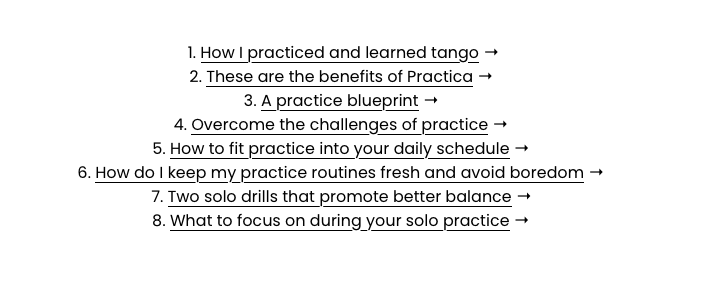
I've arranged these articles in a specific sequence, each building on the insights of the previous one. Start with the first and move through them in order—they'll take you from understanding why practice matters, to knowing exactly what and how to practice, to overcoming the inevitable challenges that arise.
Whether you're just beginning your tango journey or you've been dancing for years, dedicated practice will open doors you didn't know existed. These articles are your guide.
Let's begin.